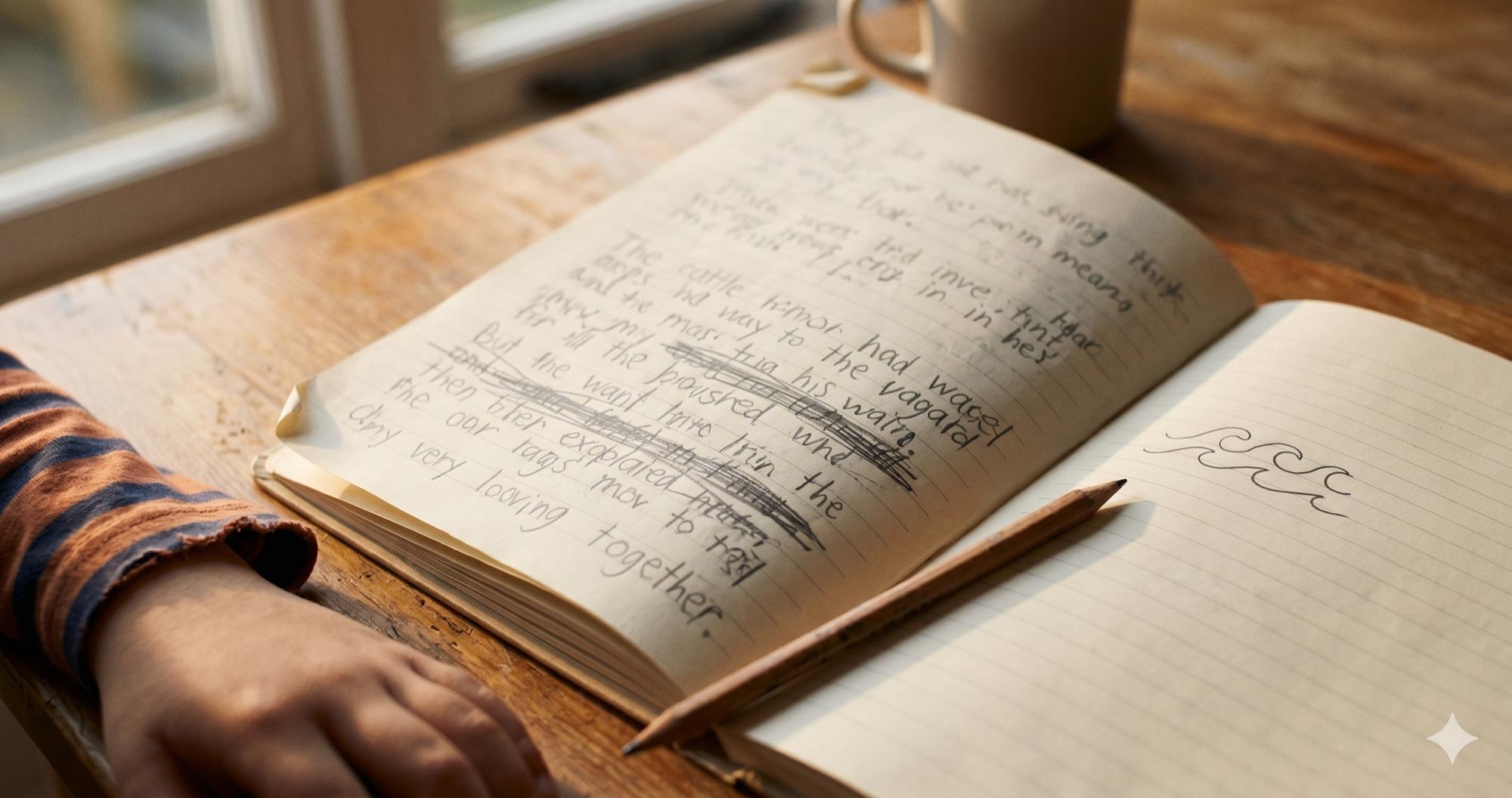
There's a book coming out of Bukmuk where the sea has no king.
The ocean is run as an anarchy. Waves hold rank, there's a strange and detailed order to it, and a young girl wave fights her way up through the whole thing to find out what she's really made of. A child dreamed that up. She'd been living in that world a long time before she wrote a word of it down.
Read "an ocean run as an anarchy" and watch what your brain does. It wants to fix it. Smooth it out, make it more realistic, ask the kid to explain herself. That feels like helping. Most of the time it's the opposite, and it took us a while to really believe that.
Kids aren't short on creativity
They've got more of it than we do. What happens is that we slowly teach them to file it down until it fits.
You can see it in the first drafts that reach us. A seven-year-old breaks every rule in the book and stumbles onto an image no adult could have written. A twelve-year-old invents a magic system tighter than half of what's on the shelf, then apologizes for it. Says it's weird.
That apology is the part that worries us.
Somewhere between the stories a kid tells out loud and the essays they hand in for marks, they learn that writing is mostly about being correct. Neat spelling, right length, the answer the teacher wanted. And the imagination, the best of it, gets quietly shifted into the "just for fun" pile.
The one line we won't cross
When we started Bukmuk Publishing, we set a single rule above all the rest. We don't rewrite a child to sound like an adult.
That doesn't mean we hand them a blank page and walk off. There's real editing here. Story coaches, a publishing manager, drafts that go round several times. Vedika's wave story started as about 30 pages in an anthology and grew past 60. That was months of real work.
But the work points one way. We help a child say the thing she's already reaching for. We don't replace it with the thing we'd have said.
The instinct to clean up a strange line is strong, and smoothing one is how you quietly delete the best thing on the page. So now, whenever an editor wants to fix an odd sentence, we stop and ask one question first. Is this confusing, or is it just unfamiliar to us? Those aren't the same thing, and they're easy to mix up.
The ocean with no king was never going to come from us. It came from a kid who hadn't yet been told that oceans in stories are supposed to be calm and blue and well behaved. Our job was to leave it standing, and help her build the world out wide enough to hold a book.
What it does to a child
She reads the finished book and finds herself in it. The odd choices are still there. The voice is hers.
When the book shows up with a real ISBN, on Amazon and in real shops, the lesson isn't "the grown-ups fixed my work." It's "what I made up was good enough to become this." That one doesn't wear off after the launch. A kid who learns young that her own imagination is worth taking seriously carries it into everything after.
We're at 5 books out now, 6 more in production, families across 12 cities, a 4.9 out of 5 parent rating. The numbers matter to us. The face a kid makes opening the box and seeing her name on the spine, over a story that still sounds like her, matters more.
One thing to try at home
Next time your child shows you something they wrote and it makes no sense to you, sit with it a second before you correct it. Ask about the part that lost you.
Good chance it isn't a mistake. Good chance it's the best thing on the page.
Not ready yet? Get the free parent's guide
Leave your name and we'll send you the free guide to publishing your child's first book. Plain answers, honest prices, no hard sell.